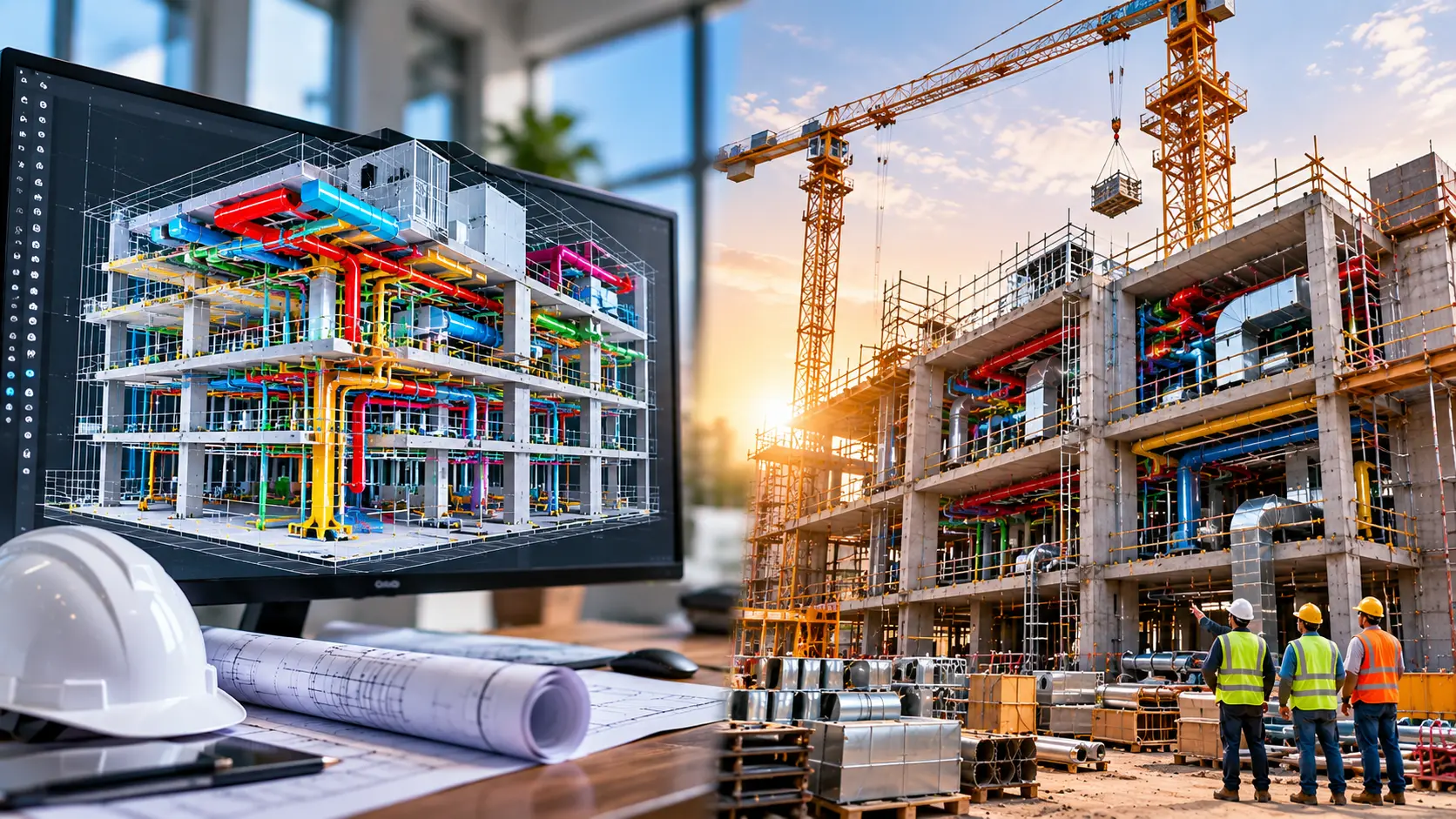
A coordinated model should resolve construction decisions before they become site problems.
A BIM model can look complete while leaving the contractor’s hardest questions unanswered.
Ducts fit. Pipes appear coordinated. The walkthrough looks impressive. Yet installation reveals missing supports, inaccessible valves, insufficient clearances and equipment that cannot reach its intended position.
The gap begins when modelling progress is mistaken for construction readiness.
Clash-free does not mean buildable
Removing geometric clashes is a starting point. Construction also requires space for insulation, flanges, supports, firestopping, installation tolerances and the people doing the work.
A service fitting within the model does not prove it can be installed.
Coordination must account for sequence
Services may fit in their final positions but become difficult—or impossible—to install after neighbouring trades complete their work.
Useful coordination considers access routes, installation order, lifting requirements and trade dependencies before drawings reach site.
Maintenance access must be practical
A clearance box alone cannot demonstrate maintainability.
Can a technician operate the valve, replace the filter or withdraw the coil? Can equipment be removed without dismantling surrounding services? These questions belong in design coordination, when changes are easier to make.
Unresolved decisions need clear ownership
Unconfirmed equipment, assumed dimensions and pending approvals must remain visible. Each needs an owner and a resolution date.
Detailed geometry can create false confidence when the information behind it remains provisional.
Information must reach the workface
Construction value depends on current drawings, agreed dimensions, coordinated openings and clearly controlled revisions. Site teams need information they can understand, trust and act on.
When this connection fails, contractors face RFIs, rework and disrupted installation. Clients inherit programme uncertainty, additional costs and operational constraints.
Measure the decisions resolved
The strongest measure of BIM is a practical question:
How many construction decisions did the model resolve before work began?
At HJVES, our focus is turning coordinated information into confidence across construction, commissioning and everyday operation.
Confidence.
Engineered.